Broken Yards: The Next Frontier for VLA
Most enterprise AI works on records and workflows, but the yard is a constantly changing physical space. Vision-Language-Action (VLA) yard management goes beyond computer vision: it combines gate and mobile camera feeds with context and history to understand what’s actually happening in the yard and trigger the right action automatically.

Most enterprise AI still operates on digital abstractions: text, transactions, records, workflows.
The yard is different.
It is a continuously changing physical environment where trucks arrive, trailers move, containers stack, doors open, equipment changes position, weather interferes, records go stale, and operational reality often diverges from the system of record. That makes the yard one of the most interesting environments for the next generation of AI.
The emerging concept of Vision-Language-Action, or VLA, is important because it moves AI beyond recognition.
VLA Yard Management
Traditional computer vision asks:
What do I see?
A VLA-oriented system asks:
What do I see, what does it mean in context, and what should happen next?
That distinction is fundamental. At Aviro360, we see the yard through two very different visual perspectives
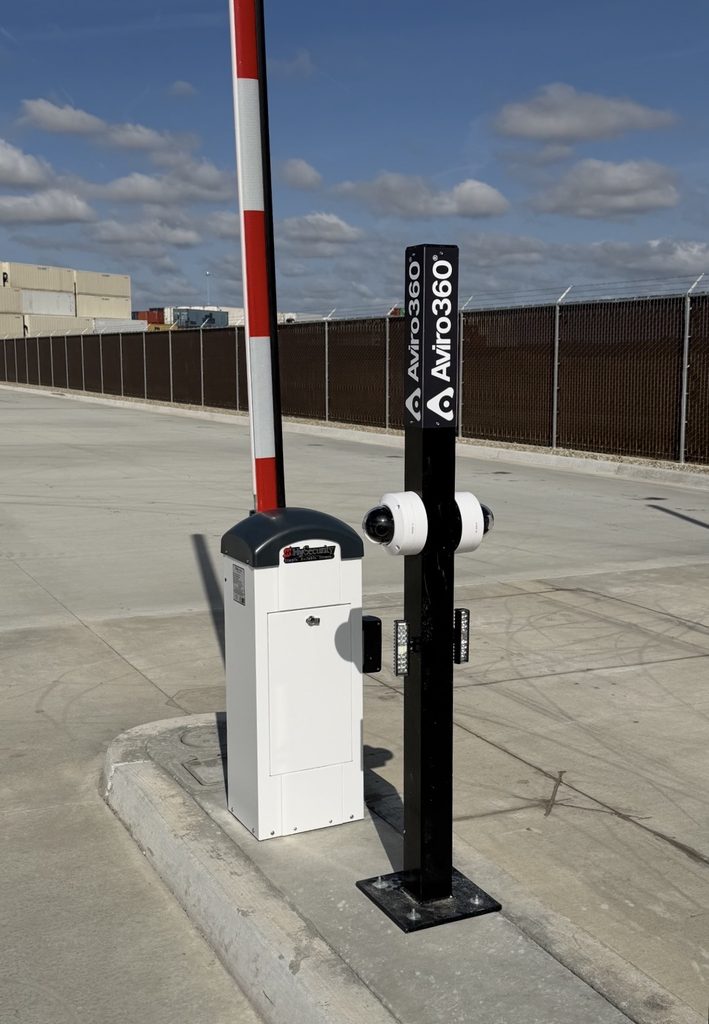
Static feeds provide high-confidence checkpoints. Gate cameras observe equipment at known locations, from predictable viewpoints, within structured workflows. They are well suited for asset identification, attribute capture, ingress and egress events, and validation against appointments, business rules and enterprise systems.
Mobile feeds provide continuous spatial awareness. Cameras and sensor units moving through the yard observe assets from changing distances, angles and environmental conditions. Combined with location data, they provide a continuously refreshed view of where equipment actually is.
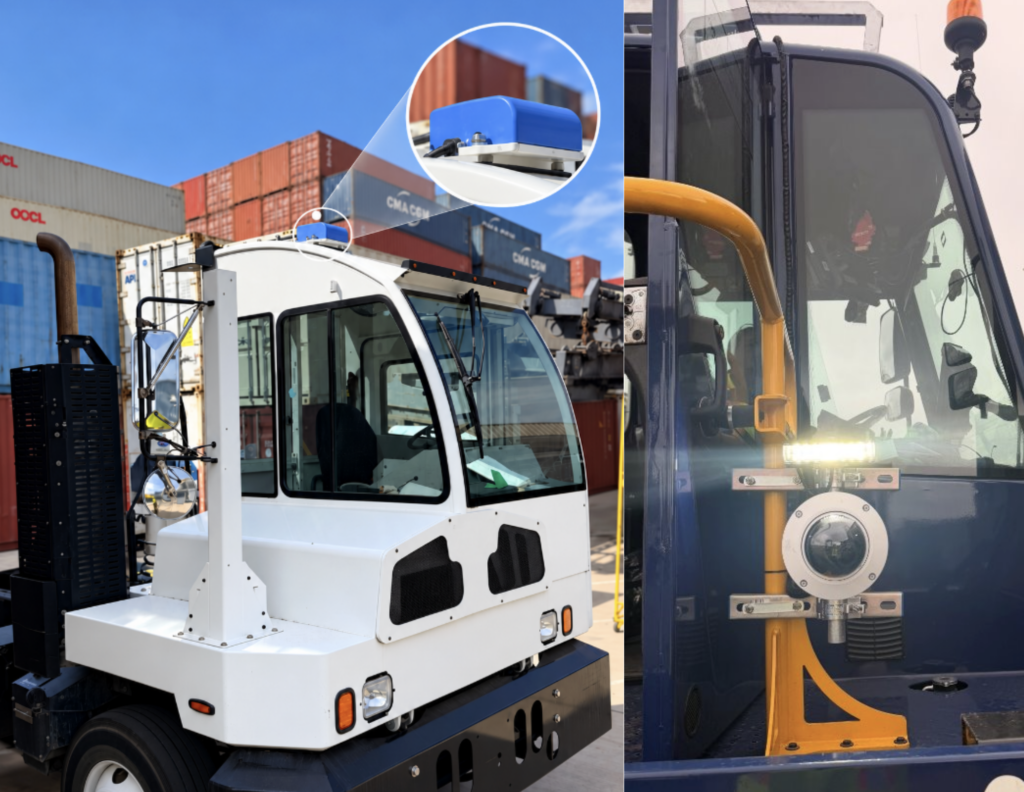
The technical challenge is not simply running vision models against both feeds. It is combining them into a persistent understanding of the physical environment.
A trailer may enter through a gate at 09:02. A mobile unit may later observe it in Spot 214. A subsequent pass may show it moved. An outbound gate event may confirm its departure.
Individually, those are detections. Together, they are a state model of the physical asset.
That is where VLA becomes powerful.
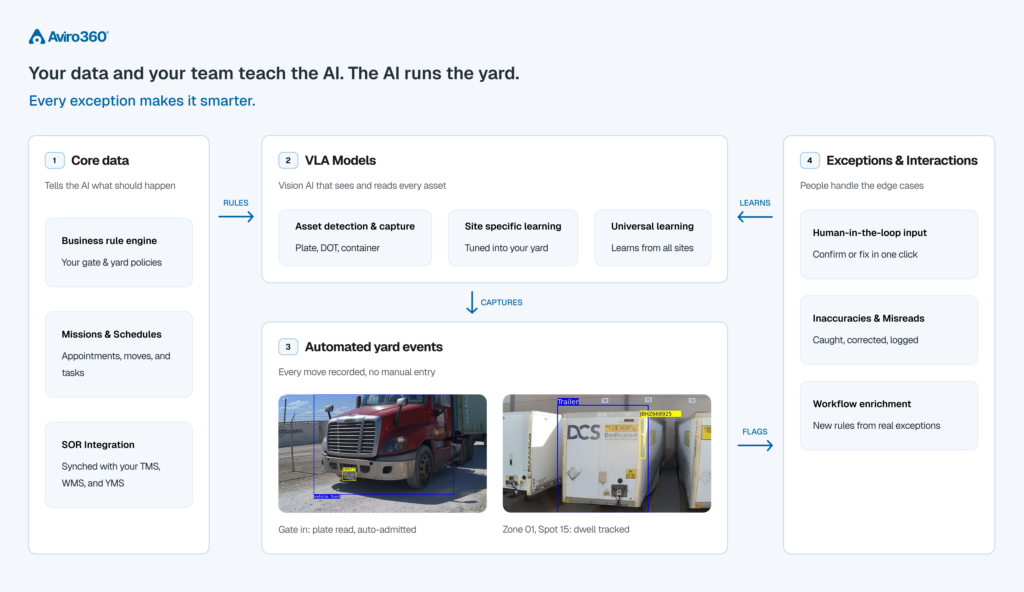
Vision: perceive
The system detects and interprets trailers, containers, tractors, chassis, plates, seals and other attributes across multiple viewpoints.
Language and context: understand
Those observations are combined with time, location, historical events, appointments, missions, business rules and enterprise data.
The question changes from:
“What asset is this?”
to:
“What is this asset doing here, is that expected, and what changed?”
Action: operationalize
The system can then convert understanding into an operational event:
- create an ingate or outgate event
- update an asset location
- reconcile inventory
- surface an exception
- trigger a workflow
- update a YMS, TMS, ERP or other system of record
This changes the architecture from:
Image → Detection
to:
Observation + Context + History → Understanding → Action
That is a much more consequential model.
Why the yard matters
The yard is not a niche edge case. It is the physical transition layer between transportation, warehouse, rail, port and manufacturing operations. And it is often where digital systems become least reliable.
Enterprise software knows what should be happening. The yard reveals what is actually happening.
That gap creates dwell, detention, lost assets, manual searches, bad inventory, unnecessary labor, missed appointments, security exposure and operational friction. So the yard is strategically important because it represents a broader enterprise problem:
How do you make software aware of physical reality?
That is the problem VLA architectures are increasingly positioned to solve.
The future of VLA is not just better vision
The provocative part is this:
Computer vision may ultimately become the sensor layer, not the product.
The real value moves upward. The differentiator will be the system that can combine many observations, understand temporal and operational context, maintain state, resolve uncertainty and trigger the correct action. In that model, the winning architecture is not the one with the best isolated camera read.
It is the one that builds the best machine understanding of the environment over time.
Static cameras, mobile cameras, enterprise systems and human corrections all become inputs into the same evolving intelligence layer. That creates a continuous loop:
Observe → Interpret → Act → Validate → Learn
And over time, the system stops behaving like a collection of sensors.
It begins behaving like an operational intelligence layer for the physical yard.
That is where we believe the category is heading. The future of yard technology is not another dashboard showing stale information about the physical world.
It is software that can continuously see the yard, understand the yard, and act on what is actually happening.
And that is a materially bigger idea than computer vision.