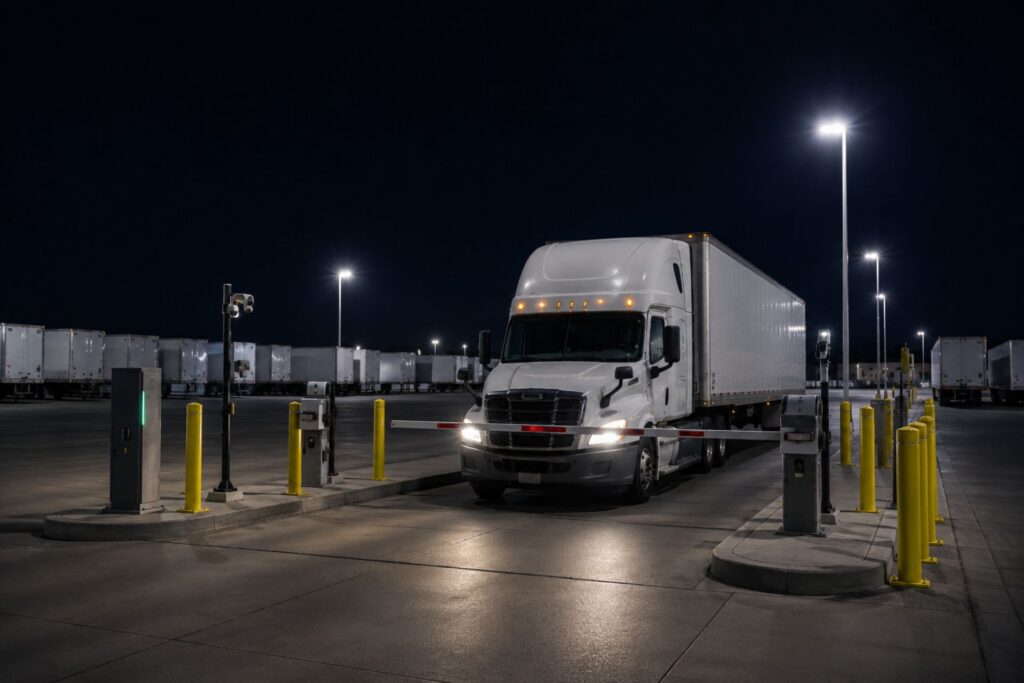
Peak Season Yard Operations: What to Observe Now for 2027 Planning
Peak distribution and holiday shipping are already underway. While yard operations teams execute today’s plan, the gaps that emerge under peak volume are the best planning input for logistics leaders will get all year. If someone captures them while they’re happening, that is.

Key takeaways
- Peak season doesn’t create new operational problems. It removes the slack that normally absorbs them. The manual counts, radio calls, and “let me check” moments that are easy to absorb at moderate volume become more visible and costly once that slack disappears.
- 93% of logistics operations already use a yard management system, yet 59% still report incomplete yard visibility (Aviro360 Yard Visibility Research, 2025).
- The most useful record of a bad peak-season night is made the night it happens
- Peak also allows operators to ask whether what went wrong was a one-off consequence of extraordinary volume, or a structural weakness that exists all year and is normally hidden by slack your operation doesn’t have during peak.
Peak season doesn’t create problems. It removes the slack that hides them.
Most operations have some amount of slack: a little extra time between moves, a late update, someone who needs to double-check something. That slack is what makes manual workarounds manageable during normal operations because there’s time and capacity to absorb them.
Peak season removes that time, though. Volume increases, staffing may not scale at the same rate, and the workarounds that were running in the background suddenly have nowhere to hide. The same manual check that took thirty seconds in June now happens more often, under more pressure, with more people waiting on the answer. What looks like a peak-season problem may be a year-round gap that peak has made easier to see.
Peak isn’t just more freight. It’s more operational complexity.
It’s tempting to think of peak as a volume problem. More trucks, more containers, more of the same work. But there’s more to it.
Peak brings more carriers moving through the same gate, more equipment types in play, and considerably more variability: late arrivals, no-shows, last-minute appointment changes, drivers rerouted mid-shift. At the same time, most operations are running lean, which means the people who’d normally absorb that variability by manually reconciling it have less capacity to do so. Right now, the physical operation is changing faster than ever.
That combination amplifies the operational consequences of yard blindness. A manual workaround that’s sustainable at normal volume and normal variability becomes hard to sustain at peak. Small delays that might otherwise be absorbed can begin to compound. Cognitive load goes up for the people running the yard, because more of their time goes to verifying what already happened instead of deciding what happens next.
Why peak season reveals what normal operations can hide
Most operators treat peak as something to survive and reflect on afterward. Leadership benefits from treating it differently: as a live stress test of the yard, running at full volume and full complexity, with nowhere for existing gaps to hide.
The scale of the underlying gap is measurable even outside of peak. In Aviro360’s research of 367 U.S. logistics professionals, 93% of respondents already run a yard management system, yet 59% still report incomplete visibility, and 54% of those who recently upgraded their YMS say blind spots persisted anyway. What peak season adds isn’t a new gap. It’s pressure that makes an existing gap impossible to keep working around quietly.
What to track during peak season for 2027 planning
The observations that matter most are specific, dated, and tied to a location or shift. Four areas are worth watching:
- Where dwell time actually accumulates. ATRI research found drivers were held on 39.3% of stops industry-wide in 2023. Fleets bill for detention 94.5% of the time and collect on less than half. During peak, track where dwell accumulates, when it occurs, and whether the same sites, shifts, or workflows repeatedly contribute to it.
- Where gate congestion originates. Slow check-ins compound quickly at volume. Note whether the bottleneck is paperwork, staffing, or driver uncertainty about routing. Each requires a different fix.
- How often teams stop to verify. Every “let me just double-check” is a countable moment and a signal that the team doesn’t have enough confidence in the available information to act without verifying it.
- Where competing priorities force a trade-off. During peak, operators are balancing several commitments at once: the site’s throughput plan, customer service commitments, carrier and rail cutoffs, labor capacity and safety, while absorbing disruptions they don’t control, like late arrivals or rail delays. Track where the operation repeatedly has to choose between those commitments or burn extra labor just to hold all of them together. The goal during peak was never simply moving faster. It’s having enough current information to make the right call quickly and execute it safely.
Seasonal vs. Systemic
When something goes wrong during peak, the next question is whether extraordinary seasonal conditions caused it or peak simply exposed a structural weakness that’s present all year. A genuinely seasonal problem might justify temporary staffing or a short-term process fix. A systemic problem can continue creating cost or inefficiency after peak has passed, even when normal operating conditions make it less obvious. Treating it as a one-time seasonal spike, when it’s a structural gap, means budgeting for the wrong fix.
Turning this season’s observations into a 2027 decision
You don’t need to solve every underlying issue mid-peak. But you do need to document it: which sites hit capacity first, which shifts fall behind, and where the manual checks became more frequent, and where the physical operation and system of record diverged, and by how much.
That record is what turns “the yard felt chaotic in November” into an actual planning input, and what lets you tell the difference between a season that was genuinely extraordinary and a gap that’s been there all along. That distinction is the difference between a 2027 budget conversation built on specifics and one built on a feeling that’s already started to fade.
Turn this season’s observations into a clearer picture of what to prioritize for 2027.
Start a planning conversation →
Frequently asked questions
-What is yard blindness?
Yard blindness is the gap between what a yard’s systems of record report and what’s actually happening on the ground — equipment locations, trailer dwell time, or gate activity that isn’t reflected in real time. It commonly persists even at sites already running a yard management system.
-Why does yard visibility get worse during peak season?
Peak season increases volume and operational complexity (more carriers, more equipment, more variability from late arrivals and last-minute changes) while staffing and available slack may not increase at the same rate. Workarounds that quietly absorb small data gaps the rest of the year no longer have room to do so.
-How do I know if a peak-season problem is seasonal or systemic?
Ask whether the gap was caused specifically by unusual volume, or whether it’s a year-round weakness that’s normally absorbed by slack your operation doesn’t have during peak. A seasonal problem may call for a temporary response, while a systemic issue may warrant a longer-term process, staffing, or technology change.
-What should operations teams document during peak season?
Don’t just log where the plan broke down. Capture what changed and how fast the team responded. Note the conditions behind any congestion or manual verification (a late train, a volume spike, carrier delays, staffing gaps), then how quickly it was recognized and adjusted for.